The Successful Junior Lawyer
Foundation Series
Give your juniors what they need
Clear direction.
That’s not just the obvious things, but also the implicit things. The things that everyone should know, but not everyone does. Juniors with lots of potential trip up simply because they don’t truly understand the reality they’re in.
We’ll help them.
This series:
Makes the firm’s implicit expectations explicit
Juniors stop guessing what “good” looks like and start directing effort toward the behaviours and decisions that actually matter at your firm.
Shortens the time to trusted autonomy
Partners don’t just want better juniors; they need juniors they can trust sooner. Improve partner capacity and workflow efficiency.
Addresses non-technical causes of underperformance
Most issues are not about legal skill, but about prioritization, context, follow-through, and professional judgment. The program targets those directly.
is immediately usable
Thanks to the practical and experiential nature of the workshops, participants leave with concrete heuristics, decision filters, and behavioural tools they can apply the next day.
Reduces avoidable anxiety and burnout
By removing guesswork, juniors gain clarity on expectations and feedback signals, which reduces second-guessing, overwork, and quiet disengagement.
Developed from industry leaders
The content of this Series came out of the Successful Junior Lawyer Project - a 1.5 year project designed to help junior lawyers succeed at their firm.
Almost 50 managing partners, chief people officers, department heads, talent directors, and regular partners were interviewed. From Am Law 10 firms to small boutiques, across Canada and the United States.
Their insights were collected, dissected, and distilled into a roadmap for associates who want to succeed (all in The Successful Associate book).
This Series — the Successful Junior Lawyer Foundation Series — covers those insights most needed for juniors as they begin their practice.
Though every firm is different,
there are universal success factors.
Factors that apply across firms and practice areas.
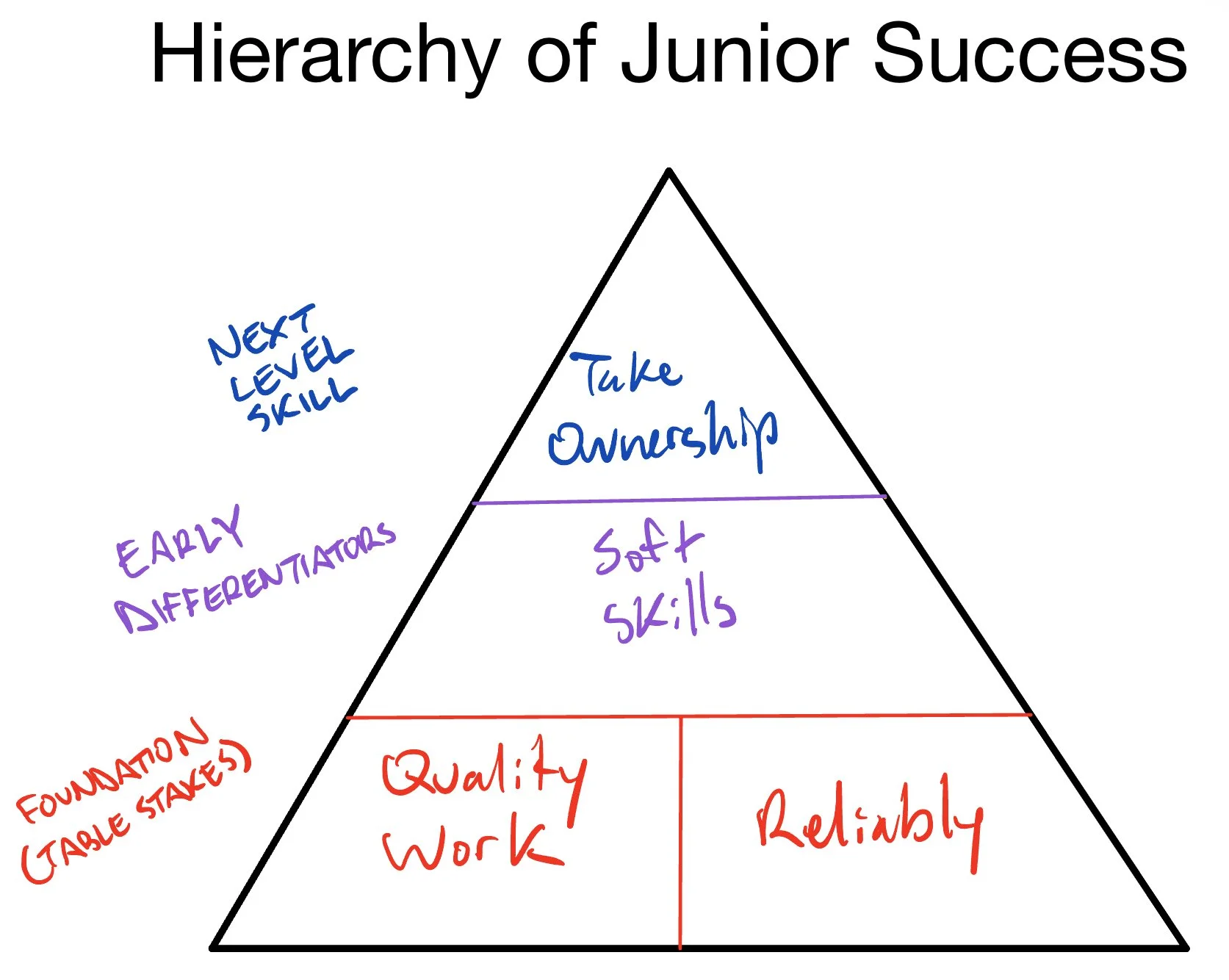
If you have an associate that can’t do quality work reliably, nothing else matters. You can’t have them helping you.
But doing quality work reliably is not a calling card, it’s a baseline requirement. What begins to separate some from the rest are the presence of people skills. The ability to meet people. Talk to people. Read a room so that they know when it’s time to offer their idea, or keep their mouth shout.
And even amongst those, there are juniors who stand out above the rest. Those who take responsibility and (appropriate) initiative. Who realize that their job isn’t just to take work off a partner’s plate, it’s to take it off their mind.
Our Process
Expectations are constantly rising. We expect more from a fifth year lawyer than a first. Far more important than how good your junior is at the start is how good they are at improving.
Improvement happens over time, which is why we include two follow-up sessions for free after the first session — each taking place a month later. So that they can lock in the learning before coming back.
The seven key takeaways as sorted across the Series/book:
Main Session:
Introduction to the Successful Junior Lawyer Framework, including key components.
Quality work and reliability are baseline requirements, not a calling card.
The Improvement Imperative — if you’re not improving, you’re falling behind.
Feedback is critical (and how to get it even when partners don’t take the time to give it to you).
Workshop One:
A deep-dive into how your reputation gets you opportunities, and how your brand, professional presence, and comportment feed into your reputation.
The Expectation Effect: How people often find in your work what they expect to find.
Workshop Two:
You must take ownership — if you’re just doing what you’re asking to do, you’re doing it wrong.
Relationships are important, and they start now.
Covered in The Successful Associate Book but not the Series:
While law is sometimes a calling, it’s always a business.
And of course, since every firm is different, part of our process is talking with you to figure out how your firm’s preferences, approach to junior success and development, and the path that most successful associates take. The material will then be tailored to your firm.
After all, our goal is to teach your juniors how to succeed at your firm.
Feedback:
“Really interesting. I liked the interactivity—it felt collaborative. The formula, the success quotient, and especially the hierarchy were hands down the most useful takeaways.”
— first-year associate“We don't often stop to think about these things, and having others talk through it was really helpful. The hierarchy made everything feel very attainable—I just need to do the things and be consistent. It really resonated when you said that not all hours are equal. I know hours matter; I just need to be more intentional about getting the right ones.”
— third-year associate“I was shocked how normal the victim mindset is at my firm, and even more shocked when I found myself feeling like a victim too. The Successful Junior Lawyer talk helped me bounce out of it—it both normalized the difficulties for me but also gave me a sense of agency. I found it super engaging and especially liked what you taught about feedback.”
— first-year associate“The hierarchy was helpful—breaking it down that way gave me confirmation of what I suspected. The feedback piece, especially around indirect feedback, was new for me and particularly valuable because it was happening in real time, not just twice a year.”
— second-year associate“The pyramid and understanding how critical volume is to my success were the most helpful pieces. It helped me see that I need to be intentional about getting enough work—and the right work—and that having a good attitude is just as important. I feel more motivated and have a structure to approach my days.”
— first-year associate“Really, really helpful. There's actually a chart at our firm that lays out the skills needed to succeed, and the hierarchy covered all of it—but in a much more streamlined and clear way. The exercise around getting feedback, in particular, was very practical.”
— third-year associate
Beyond the Workshop: Alex's Story
“In retrospect, I think I just hit all my goals and stopped making new ones. I made it to the firm and just settled in.”
Alex was coasting—doing the tasks assigned but never digging deeper. After our Foundation Workshop Series, everything changed. He started understanding full file context, taking ownership, and planning ahead.
“Now I see the importance of it,” he said. “And I want to succeed here, so I'm going to do what it takes.”
[Read Alex's full story →]
Help your Juniors learn how to help themselves
Let’s see if there’s a fit for this Series at your firm.